
 Sophie Willow
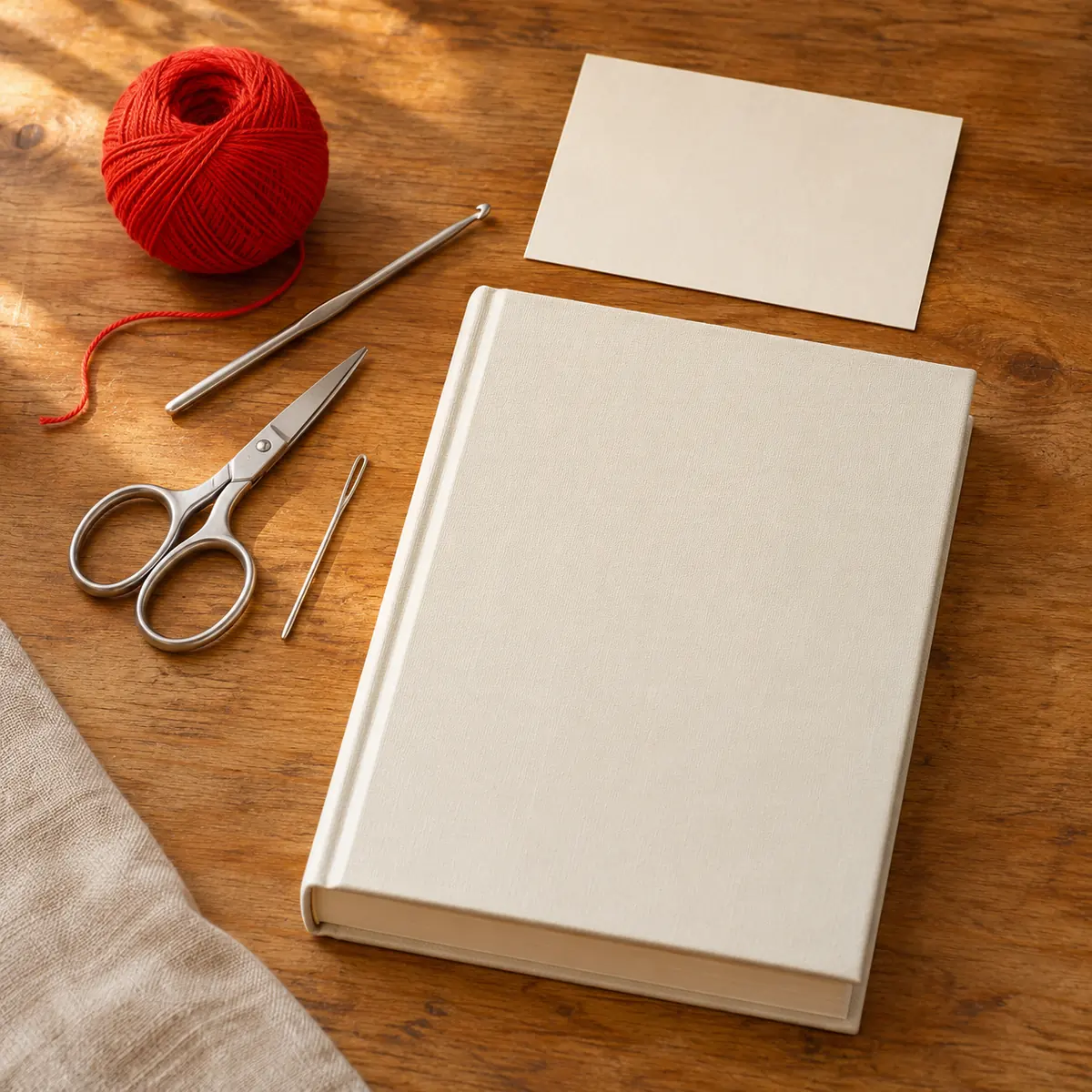
A small handmade bookmark can accompany a book without becoming a thick decoration between its pages. This bookworm uses a long free chain for the narrow tail and a short curled section at the top. Only thirteen chain positions receive paired double crochet stitches. The rest of the chain is not filled with a worked worm body. This gift-focused version keeps the complete source route and gives the drying and eye attachment their own place before presentation.
Plan the book gift · Choose the fine scrap · Make the bookmark · Dry and finish · Review before wrapping
Let the actual book guide presentation
The long chain belongs between pages while the short curl sits outside the top. Think about those two roles before choosing how to present the bookmark. A closed book should not be used to flatten a damp chain or hide an incompletely finished piece. Complete the separate drying stage first. Once the yarn and any glue are fully dry, compare the arrangement gently with the book intended for the gift.
A single solid vermillion-red yarn is a possible colour choice. It is optional and does not add a colour-change instruction. The source calls for a fine scrap, approximately 1.2 m, with a small matching hook described as US size B or similar. Keep that source estimate and reference intact. It supplies neither a numerical millimetre conversion nor a finished length that can be promised for every yarn.
Keep the yarn and hook information
A plain card can name the actual yarn and chosen hook. If you record a dimension, measure the finished dry sample and label it as your observation. No fixed size, gauge, fibre or making time comes with the source. Do not turn the estimated scrap length into a guarantee of exact consumption. A tiny project still benefits from truthful material notes when it is handed to someone else.
The worked-body spiral worm is a separate small project. Here the purpose is a narrow free-chain tail with a short curl, not a long body covered in stitches. Keep that distinction when choosing a sample or comparing pictures. A familiar worm silhouette does not make the foundation counts or intended placement interchangeable.
A fine yarn scrap and a small hook
The source calls for approximately 1.2 m of fine scrap yarn and a matching small crochet hook, US size B or similar, plus scissors and a yarn needle. It also specifies 2 tiny wiggle eyes and craft glue. Alternatively, embroider 2 small eyes using contrasting yarn. A numeric hook size in millimetres is not provided, so use the stated size reference rather than treating a guessed conversion as a source measurement.
The approximately 1.2 m yarn length is a source estimate. The exact amount used depends on the selected yarn and how you work. Check your available scrap before starting and keep enough end for secure finishing. No fixed finished length, gauge, fibre or working time is given. The chain count is the technical reference supplied by the source, not a promise that every yarn will produce the same bookmark dimensions.
US crochet terms
This version uses US terminology. Ch means chain, dc means double crochet and sl st means slip stitch. The loop sitting on the hook is not counted as a chain. When you count back from the hook, locate the completed chain links below that loop. The first worked pair of double crochet stitches goes into the third chain from the hook, not into the active loop or the second chain.
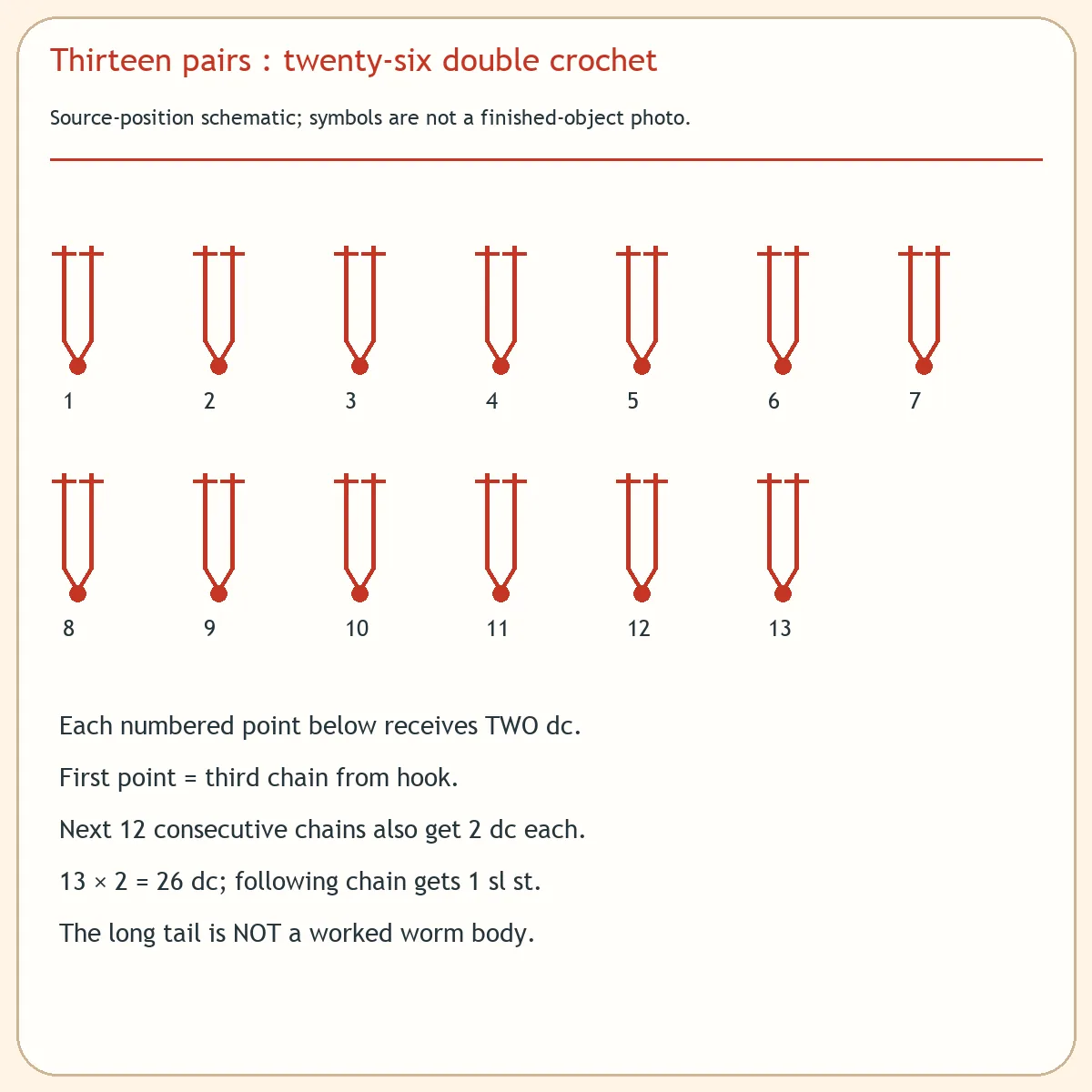
A double crochet pair shares one insertion point: work both stitches into the same chain before moving to the next. The pattern uses thirteen consecutive insertion points, each receiving two double crochet stitches. Count those positions separately from the total number of stitches, so that twenty-six stitches do not become twenty-six worked chains by mistake.
Bookworm bookmark: complete instructions
Begin with seventy chains
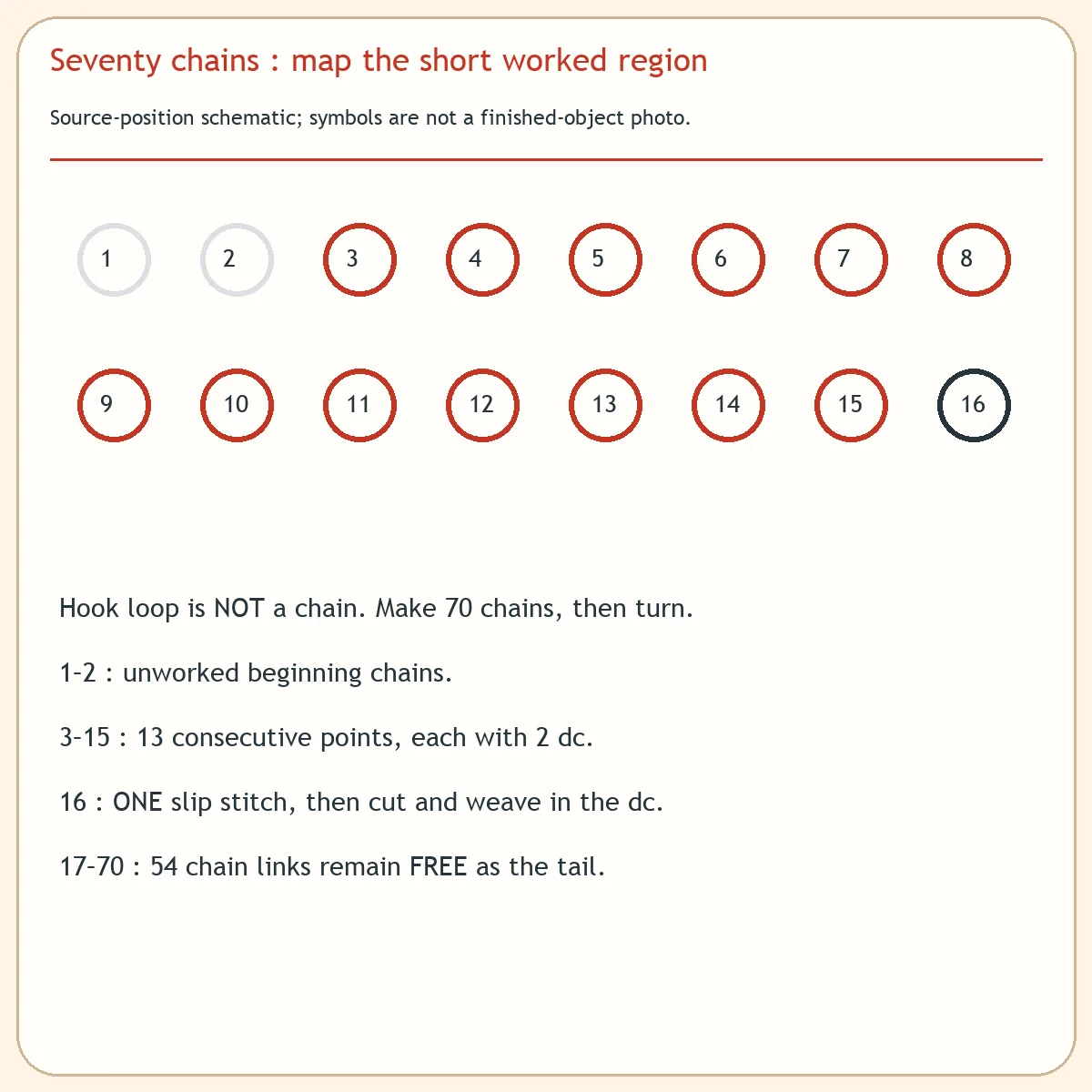
Ch 70 and turn the chain. Do not count the loop on the hook. Most of the chain remains free and forms the tail.
Work the short spiral worm
Work 2 dc in the third chain from the hook. Work 2 dc in each of the next 12 chains as well. You now have 26 dc in 13 insertion points. Work 1 sl st in the immediately following chain and cut the working yarn. Weave it into the double crochet stitches.
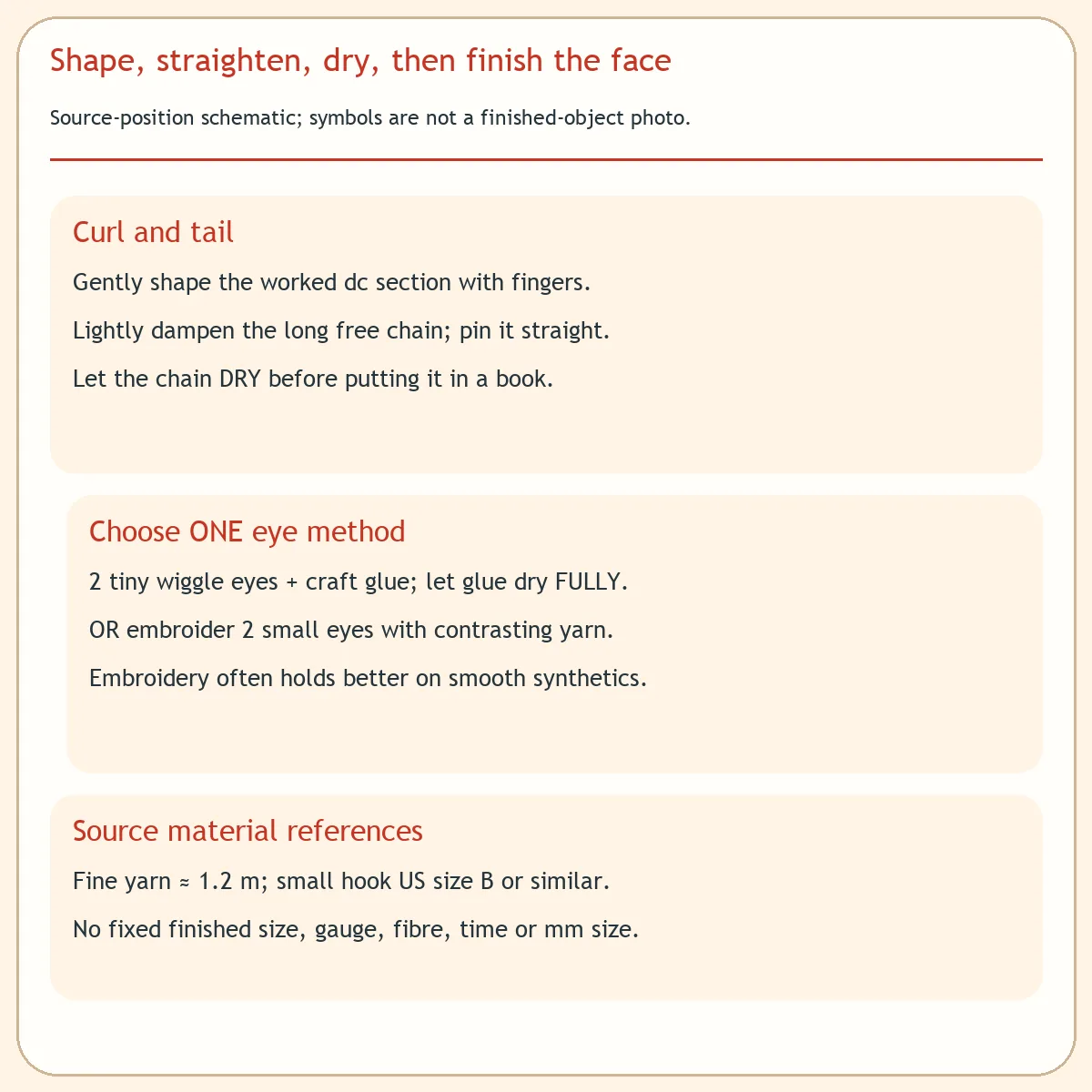
Gently twist the double crochet section into shape with your fingers. The doubled number of stitches along a short section of chain makes it curl by itself.
Straighten the tail and attach the eyes
Lightly dampen the long chain tail and pin it straight on a suitable surface. Allow it to dry before putting the bookmark into a book. Glue the wiggle eyes to the spiral section and let the glue dry completely. Embroidered eyes often hold better on smooth synthetic fibres.
Review the bookmark in the order it will be used
First confirm the narrow tail remains free
The source begins with seventy completed chains and excludes the active loop from that number. Work the first pair of double crochet in chain three, then a pair in each of the next twelve. Only those thirteen points receive tall stitches. After the following slip stitch, the long remainder stays a chain. That unworked part is the intended bookmark tail, not an unfinished decorative section.
If the sample looks like a long worked worm, check how many chain positions received pairs. Twenty-six is the number of double crochet, not the number of worked chains. Thirteen pairs on thirteen consecutive points are required. A mistake can preserve the familiar stitch rhythm while producing the wrong construction. Count the supporting positions before deciding that a larger curl is merely a different presentation.
Then inspect the short worked end
The first two chains remain before the worked section. The thirteen occupied points run from the third through the fifteenth chain counted from the hook. Position sixteen receives the slip stitch. Fifty-four links beyond it remain free. This arithmetic describes the source route and helps distinguish the small curl from the long tail. It is not a measurement in centimetres and does not prescribe a stretched tail length.
After the slip stitch, cut the working yarn and weave it into the double crochet as written. Do not run an unfinished strand down the chain and call it part of the tail. The tail and the working end have different roles. Keeping them distinct makes the narrow portion easier to inspect before the bookmark is placed near paper.
Shape the curl gently
Gently twist the worked section into its curl with the fingers. The doubled stitch count on a short chain encourages that curve. Shaping is a finishing action after the thirteen pairs are complete, not a substitute for checking the number of destinations. If the curl is unexpectedly long, recount before winding it more tightly or continuing stitches along the tail.
Fine yarn and a matching small hook remain the source materials. A thick worked body should not be shown as if it were this narrow bookmark. The source does not establish a fixed finished size, so compare the actual dry sample with the intended book. Record the chosen tools if you want to understand differences between later samples.
Prepare the chain away from the pages
Lightly dampen the long chain and pin it straight on a suitable support. Let it dry before use. The source’s order protects the distinction between shaping a handmade object and placing it inside a book. The pages should not be asked to serve as the pinning surface or the means of pulling a damp tail straight. Finish that operation separately.
No final stretched measurement is supplied. Straightening the chain does not mean lengthening it to an invented target. Keep it recognisable as the original chain and follow the real yarn information when handling moisture. Before presentation, make sure the shape has settled and the chain is no longer being held by the finishing support. Then assess the actual bookmark as a whole.
Choose one eye method and complete it
The source allows two tiny wiggle eyes attached with craft glue or two embroidered eyes made with contrasting yarn. Choose between those options rather than treating both as mandatory layers. Glued eyes belong on the spiral. The glue must dry completely before the item goes near a book or is wrapped. A photograph of attached eyes cannot establish that the drying stage has actually happened.
For the alternative, embroider two small eyes with the contrasting yarn mentioned in the supplies. Keep the ends in the worked curl, leaving the long tail narrow. The source notes that embroidery often holds better on smooth synthetic fibres. That is a comparison of attachment methods, not a requirement to use synthetic yarn for every bookmark and not a guarantee about an unspecified fibre.
Inspect the finished attachment
Look at the attachment, the hidden ends and the free tail in good light. Such inspection is useful, but it is different from documented long-term use or an adhesion test. Avoid promising permanent attachment based on how neat the eyes appear. Describe the actual material choices and completion steps instead. Keep the actual material and chosen eye finish with the bookmark.
The source gives no decorative fringe, bead or additional tie. If a gift card accompanies the book, let it remain presentation rather than secretly becoming an extra component of the bookmark pattern. The chain, curl and chosen two-eye method already form the complete source object. Preserve their order and their proportions instead of adding unrequested weight to the narrow tail.
Wrap after a final view of both regions
Lay the finished bookmark beside the book first. Confirm that the curl is the short worked region and the rest is a free chain. Check the twenty-six double crochet across thirteen positions and the immediately following slip stitch if any part remains uncertain. Once dry, compare its actual placement gently. Do not force the curl between pages or use a tight closure to flatten an incorrect thick body.
The granny earrings gift project offers another way to use a small amount of yarn, with its own assembly and dimensions. It does not supply attachments for this bookmark. Browse the pattern collection or author page for further gift ideas. Keep this one simple: a narrow dry tail, a short shaped curl, finished ends and accurate material notes.