
 Sophie Willow
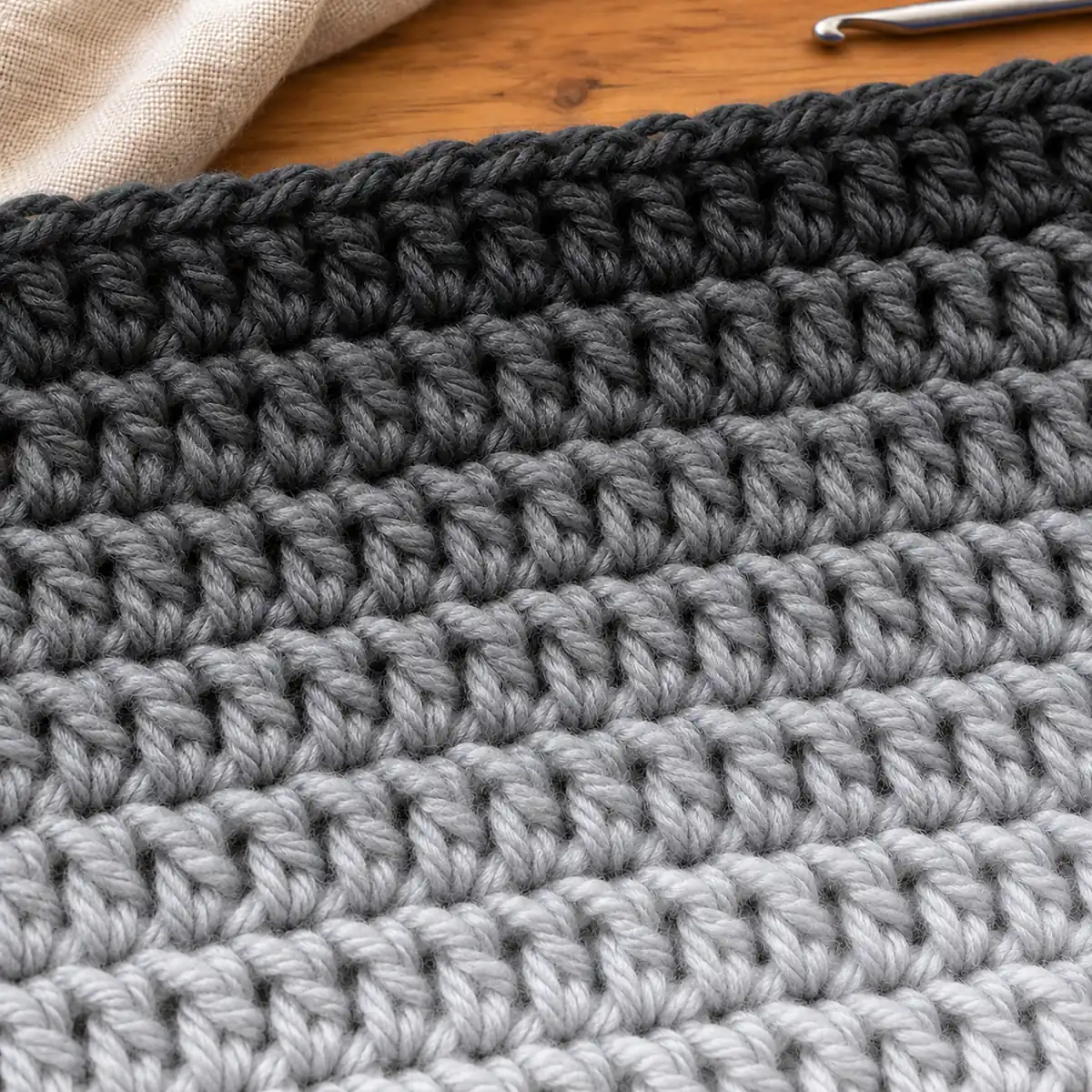
A gradient blanket lets one repeated stitch carry a larger gift without changing the stitch pattern whenever the colour moves. The source offers a small blanket and a sofa version, both made in turned double crochet rows. Choosing the intended scale comes before choosing how to present it. This page preserves the two complete size lines, the alternative foundation and the dark-to-light entry sequence of the yarn cakes. Finished dimensions are approximate. A measured sample and the actual yarn information make the gift plan more reliable than a promise of an exact size.
Choose the gift scale · Materials and versions · Complete blanket instructions · Gradient and finishing · Review before presenting
Think about where the finished blanket will go
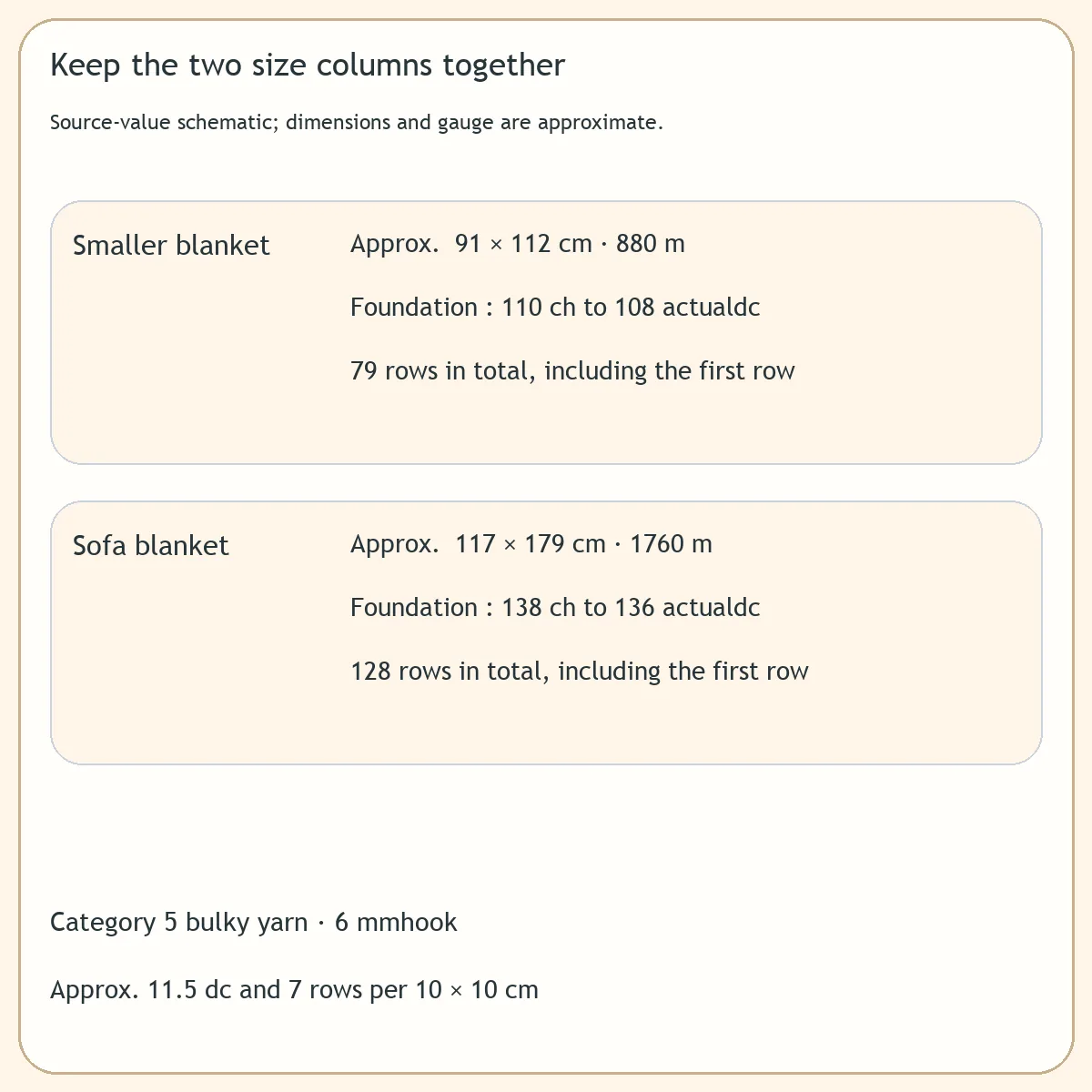
The smaller source version is approximately 91 × 112 cm; the sofa blanket approximately 117 × 179 cm. Those descriptions help start a conversation about scale, but neither establishes every use for every recipient. Compare the intended space with a real sample and the source guidelines. The pattern does not provide a tested promise about warmth, washing performance or fibre suitability.
Retain the labels of the category 5 yarn you select. The source specifies length in metres rather than weight in grams or a named product. A gift note should use the actual fibre and care information from those labels, not an imagined composition based on the yarn looking soft. No precise making time is supplied; plan progress by completed rows.
Keep the larger version's extra sequence visible
The sofa version uses 1,760 m, 138 starting chains, 136 double crochet per row and 128 rows. The small version uses 880 m, 110 chains, 108 double crochet and 79 rows. The larger one also retains the third and fourth cake entries in the gradient sequence. Do not take the smaller row count simply because the first two yarn cakes have been used.
The classic granny gift sample is a useful smaller exercise in completing and measuring fabric. This blanket is not assembled from those squares, and their corner rules do not transfer. Keep the complete blanket instructions together when choosing a larger gift commitment.
Source materials, gauge and two sizes
Use category 5 bulky yarn and a 6 mm crochet hook. The source gauge is 11.5 dc and 7 rows over approximately 10 × 10 cm. Finished dimensions are guidelines. Measure your sample before choosing a foundation for a specific measurement. These source counts are preserved, not silently recalculated from the rounded gauge. No brand, fibre composition, gram weight or making time is specified.
| Version | Approximate dimensions | Yarn length | Initial chains | Dc per row | Total rows |
|---|---|---|---|---|---|
| Small | 91 × 112 cm | 880 m | 110 | 108 | 79 |
| Sofa | 117 × 179 cm | 1,760 m | 138 | 136 | 128 |
US terms apply: ch means chain and dc double crochet. A foundation dc creates a base link and a double crochet together. Scissors, a yarn needle and an edge marker support the stated finishing and edge identification. The alternative foundation uses 108 or 136 completed foundation dc, matching the chosen row count rather than the initial chain total.
Work the foundation and the first row
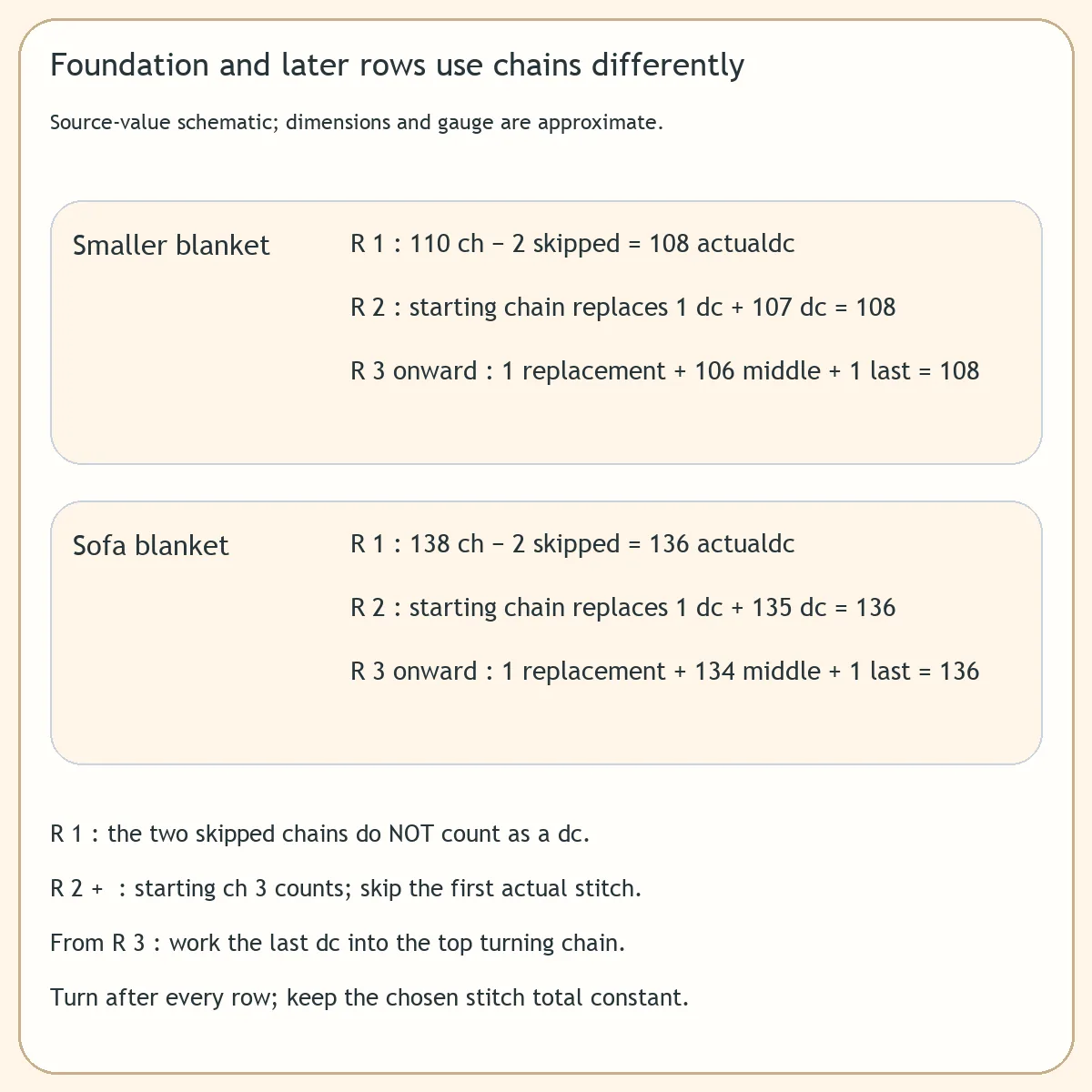
Chain 110 for the smaller blanket or 138 for the sofa blanket. Starting in the third chain from the hook, work 1 dc in every chain. The two skipped chains do not count as a dc in this foundation row. Turn after working 108 dc for the smaller version or 136 dc for the sofa version.
Alternative: foundation double crochet
Alternatively, work the same number of foundation double crochet stitches: 108 for the smaller blanket or 136 for the sofa blanket. Begin with ch 3, yarn over and draw up the yarn through the third chain from the hook. First draw the yarn through one loop to form the foundation link. Then complete the dc by drawing through two loops twice. For the next dc, yarn over and insert into the new foundation link.
Repeat the row while keeping the count constant
Chain 3 to replace the first dc of the new row. Skip the first stitch at the base of that chain and work 1 dc in every remaining stitch. From the third row onward, work the final dc into the top turning chain of the previous row. Turn after every row and keep the stitch count constant.
Repeat this row through row 79 for the smaller blanket or row 128 for the sofa blanket, inclusive. An edge marker helps you find the top turning chain when you work back towards it.
Arrange the gradient symmetrically
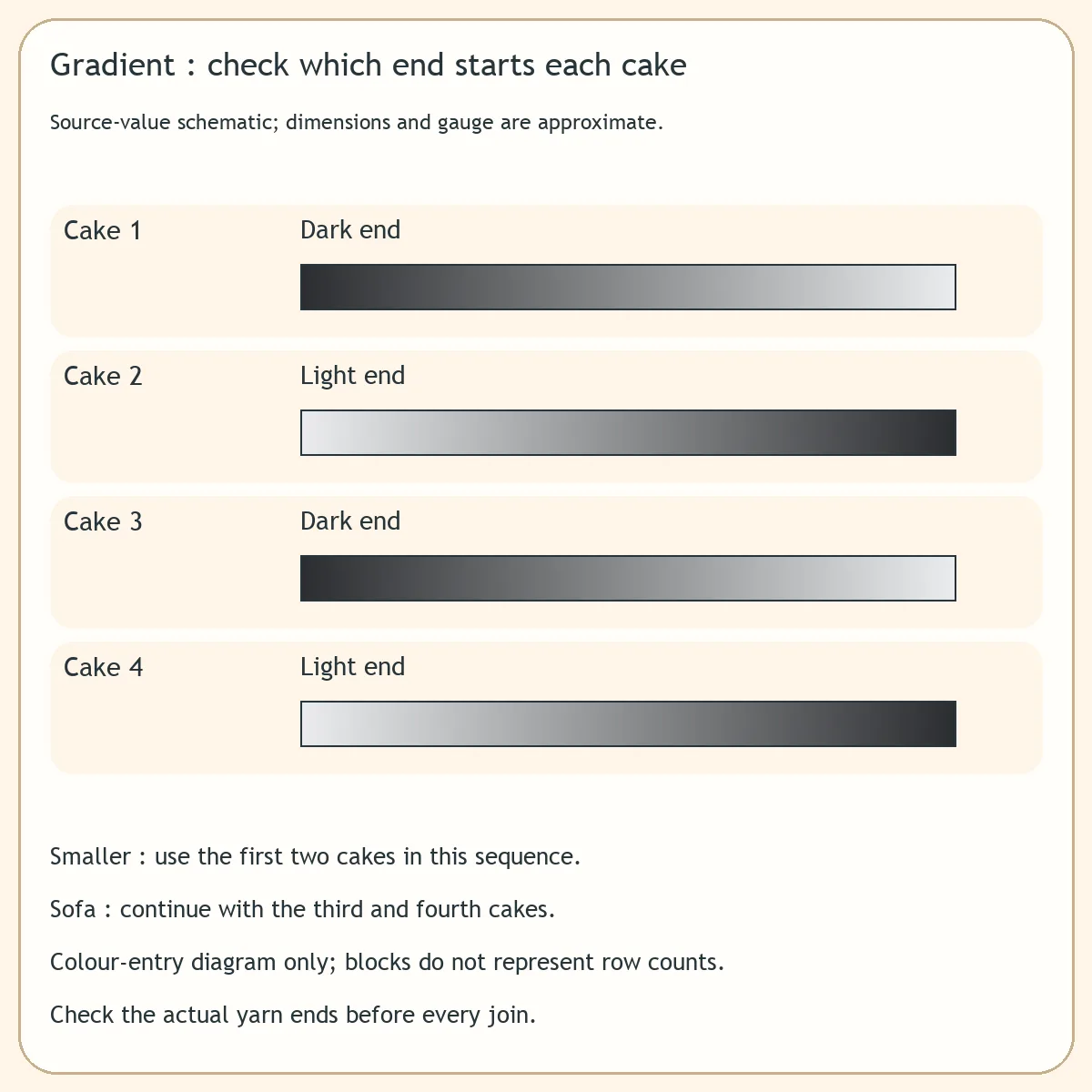
Begin the first cake at its dark end. Join the second cake at its light end so that the gradient reverses and ends dark again. For the sofa blanket, begin the third cake at its dark end and the fourth at its light end. Before every change, check which ends match in colour.
After the final row, cut the yarn, draw it through the loop and weave in the ends. Block the blanket flat if needed.
Review the work while its edges remain easy to inspect
Keep both foundation options attached to the same version
The ordinary chain foundation has two skipped chains that do not count as a double crochet. It produces 108 actual stitches from 110 chains, or 136 from 138. The alternative creates the same number of actual foundation double crochet. It is not an additional row after the chain method. Choose one route and retain the selected version's count.
For foundation double crochet, the base link is formed by drawing through one loop before completing the double crochet with two pull-throughs of two loops. The next stitch goes into the new base after a yarn over. A hurried start that misses the base-making movement is a different action, even if the strip initially looks like a usable edge. Resolve the method before accumulating a whole blanket's width.
Check the edge before hiding it under a fold
In later rows the beginning chain three replaces the first double crochet, so the first actual stitch at its foot is skipped. From row three onward the final double crochet enters the top turning chain of the previous row. Those two rules keep the count steady at both sides. A neatly folded photograph can conceal a narrowing or widening edge, so inspect the actual spread fabric before presentation.
An edge marker can help you find the turning chain while working back. Keep it tied to the real destination rather than moving it to cover an uncertain count. If an edge looks different, count the completed row and check its first and final positions. Adding a decorative border is not a source-supplied solution to an uncorrected edge error.
Let the gradient reverse as written
Begin the first cake at the dark end and the second at the light end. The source uses that connection to reverse the progression and end dark again. For the sofa blanket, begin cake three dark and cake four light. Check the ends that actually meet at each change. Their location inside or outside a cake is not a substitute for inspecting the colours.
The pattern does not assign a brand, colourway name or fixed sequence of named shades. Nor does it divide each colour into a specified row band. Preserve the dark/light directions and observe where the actual yarn changes shade.
Count the first row in the full gift plan
The foundation is included in the total of 79 or 128 rows. Record the last completed row, not just the number of repeated rows after the beginning. Turn after every row. A colour boundary is not a signal to turn early or stop short. The material's colour movement and the written row count remain separate parts of the project.
A pause note can say whether the current row is complete and whether the next beginning chain has been made. That information is more helpful than “nearly finished”. It lets you return without adding another chain or skipping a far-edge stitch. A long gift project benefits from a clear record of its actual state, with the next unfinished action identified.
Use approximate dimensions honestly
The source gives 11.5 double crochet and seven rows per approximately ten centimetres alongside its approximate end dimensions. Rounded gauge values do not establish exact arithmetic agreement with all the listed measurements. Preserve the source numbers and measure your sample. Do not silently change a row total to fit a promised wrapping box or display space.
If an exact finished dimension matters, the difference needs a separate design decision before committing to the source version. A recipient can understand a guideline measurement clearly described as approximate. Use the actual relaxed dimensions when planning its place. Keep your own measured result with the actual yarn and hook information at finishing.
Finish the real blanket before packaging it
After the final row, cut, draw through the loop and weave the ends as stated. Block flat if needed, following the actual material information. Check the reverse as well as the visible face for unprocessed ends. A tail tucked into a fold for a photograph has not received the source finishing step. Do not attach a label over an unresolved area to make it disappear.
The Sunburst gift sample and granny earrings offer separate smaller projects with their own construction. Explore the pattern collection and Sophie Willow's author page for other ideas. Complete the source edges and keep the actual yarn care information with the blanket.