
 Sophie Willow
Whispering Lace makes a delicate-looking sample whose open centre deserves to remain visible when it is presented. It is one square, not a complete finished bag or household textile. Start by making all seven rounds, then measure the actual edge before deciding how the motif might join a larger gift. The source uses DK yarn for an approximately 13 cm side and also allows Aran, without a fixed hook diameter. This page keeps the full anchoring sequence and finishing, including the late formation of four final corners.
Plan the sample · Choose supplies · Seven complete rounds · Finish for presentation · Review the lace
Let the open centre be part of the presentation
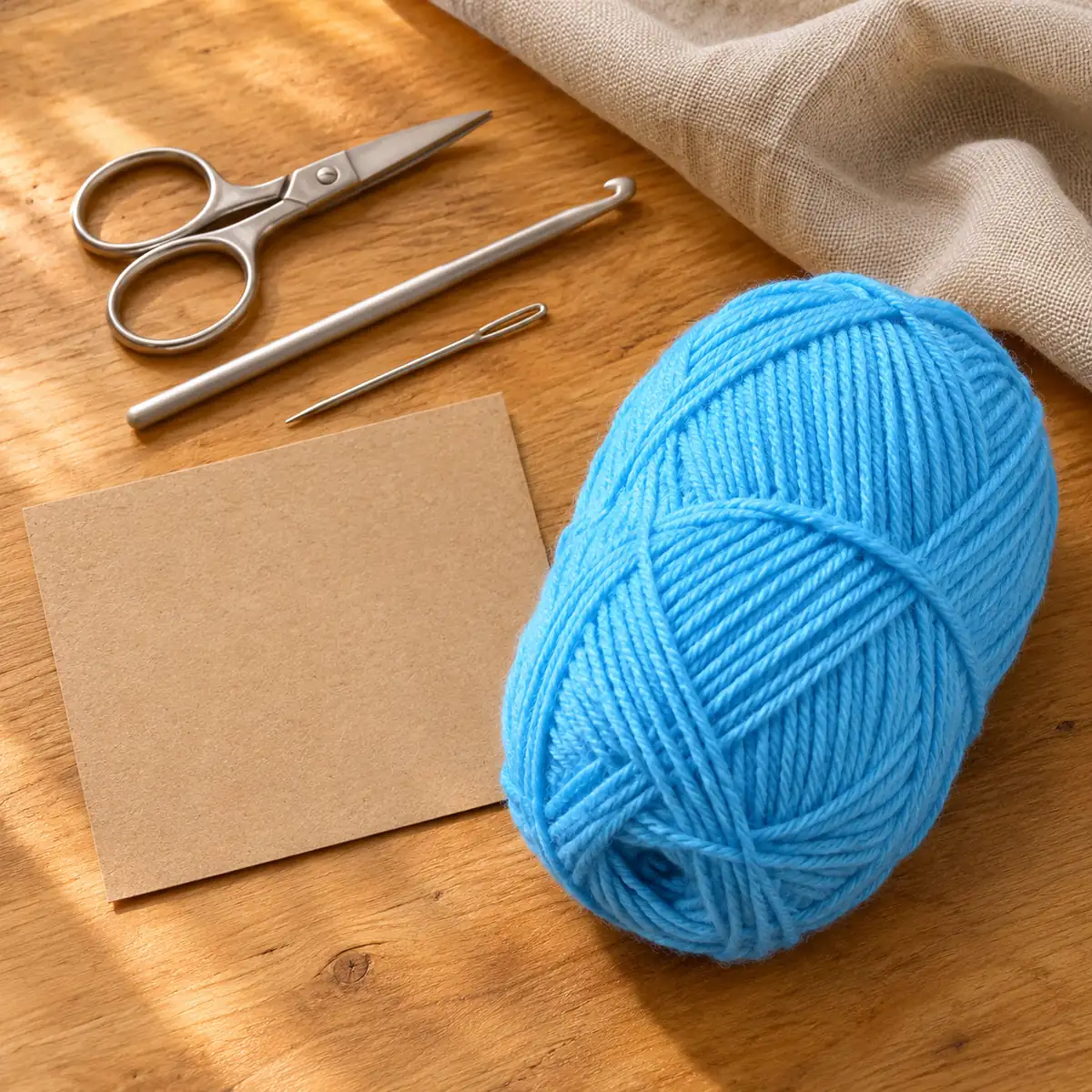
This interpretation suggests a single solid bright sky-blue yarn. The colour is a styling option, not a required source material. Place a finished sample on a plain contrasting card or cloth to see its openings clearly. A busy pattern behind the lace can visually fill its holes and make the motif look denser than it is. Changing the background does not require changing the crochet.
Keep the yarn label and the hook you actually selected in your notes. The source supplies no fibre, yardage, gram weight, gauge or making time. Keep the selected yarn label and relaxed sample measurement with the gift card. Approximately 13 cm describes the DK source example, not a promise attached to the optional Aran version.
Finish one square before planning a set
A larger textile needs its own joining arrangement and material estimate. The open centre alone does not establish a lining, backing or seam. Complete the sample, measure it lying flat and compare it with any intended neighbouring motifs. The classic granny square sample offers a different centre for comparison while retaining its separate construction.
Choose the intended presentation after the final edge is complete. Early long arches do not yet show the final outline. Calling an unfinished middle a smaller complete version would hide the corner and edging rounds that belong to the source. A recipient or later maker benefits from knowing whether they are looking at a finished sample or an active work in progress.
Source yarn and stitch vocabulary
The source uses DK yarn and gives an approximate side length of 13 cm. Aran yarn is also possible, without a separate fixed measurement supplied for it. Choose a hook suitable for the yarn and measure the first square lying flat before making several motifs. No fixed hook diameter, fibre, yarn length, gram weight, gauge or making time is given. Keep your actual yarn and hook details with the sample.
US terms apply: ch is chain, sl st slip stitch, sc single crochet, hdc half double crochet, dc double crochet and tr treble crochet. Working around an arch means under the chain span. Anchoring into a named stitch means using that specified stitch, not the nearest open space. Beginning chains count as stitches only where stated; round four's single chain is a height aid.
Rounds 1 to 3: build the long arches
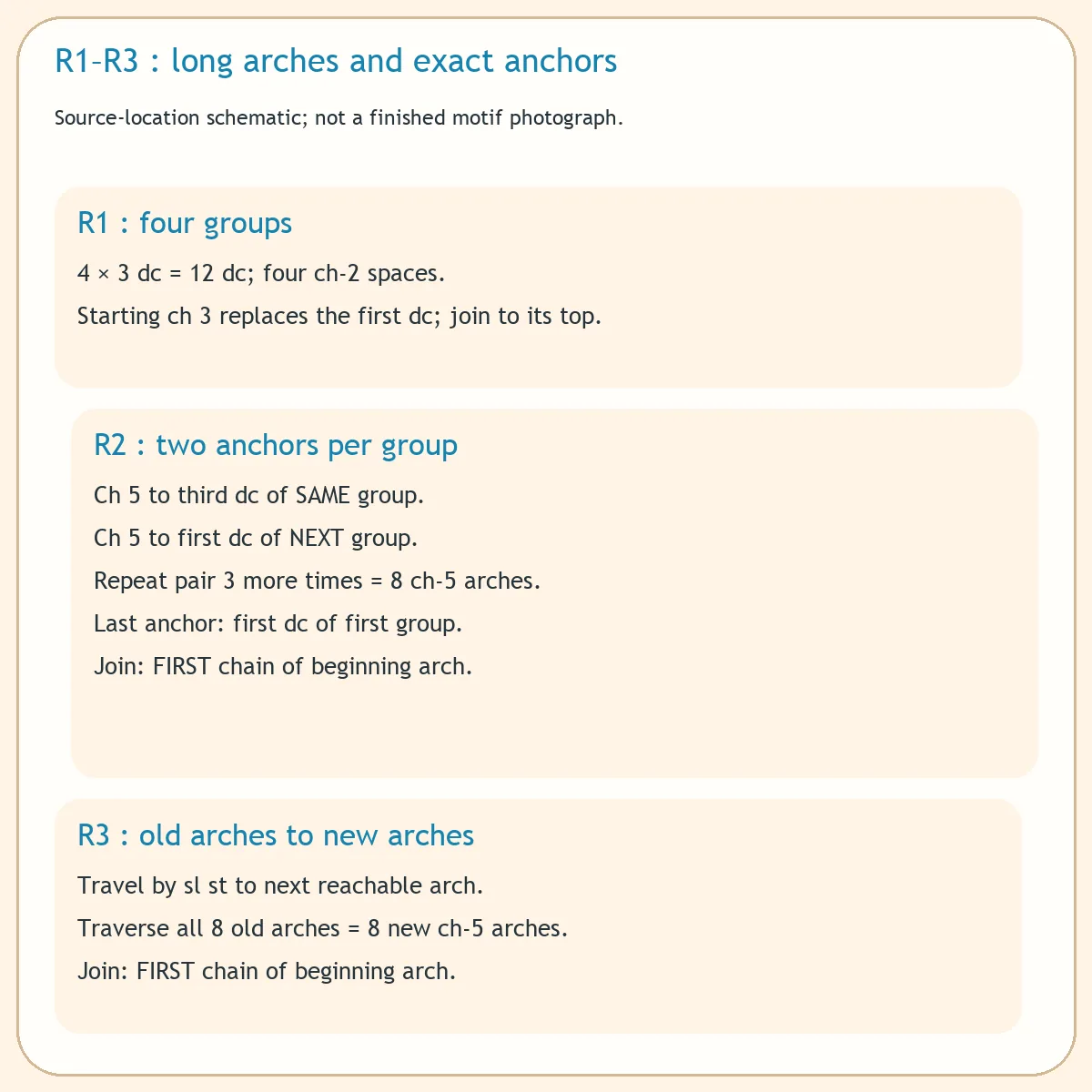
Round 1
Into a magic ring, ch 3 as the first dc, work 2 dc and ch 2. Work (3 dc, ch 2) into the same ring 3 times. Pull the ring closed and join to the top beginning chain. The hook is now at the first dc of the first group. Check: 4 three-dc groups and 4 ch-2 spaces.
Round 2
Ch 5 and anchor with 1 sl st in the third dc of the same group. Ch 5 and anchor in the first dc of the next group. Repeat these two arches 3 times. The final anchor lands in the first dc of the first group. Join with 1 sl st in the first chain of the beginning arch. Check: 8 ch-5 arches.
Round 3
Slip stitch into the next reachable ch-5 arch. Ch 5 and work 1 sl st around the next arch. Repeat until you have worked through all 8 arches. Join with 1 sl st in the first chain of the beginning arch.
Rounds 4 and 5: double the number of arches
Round 4
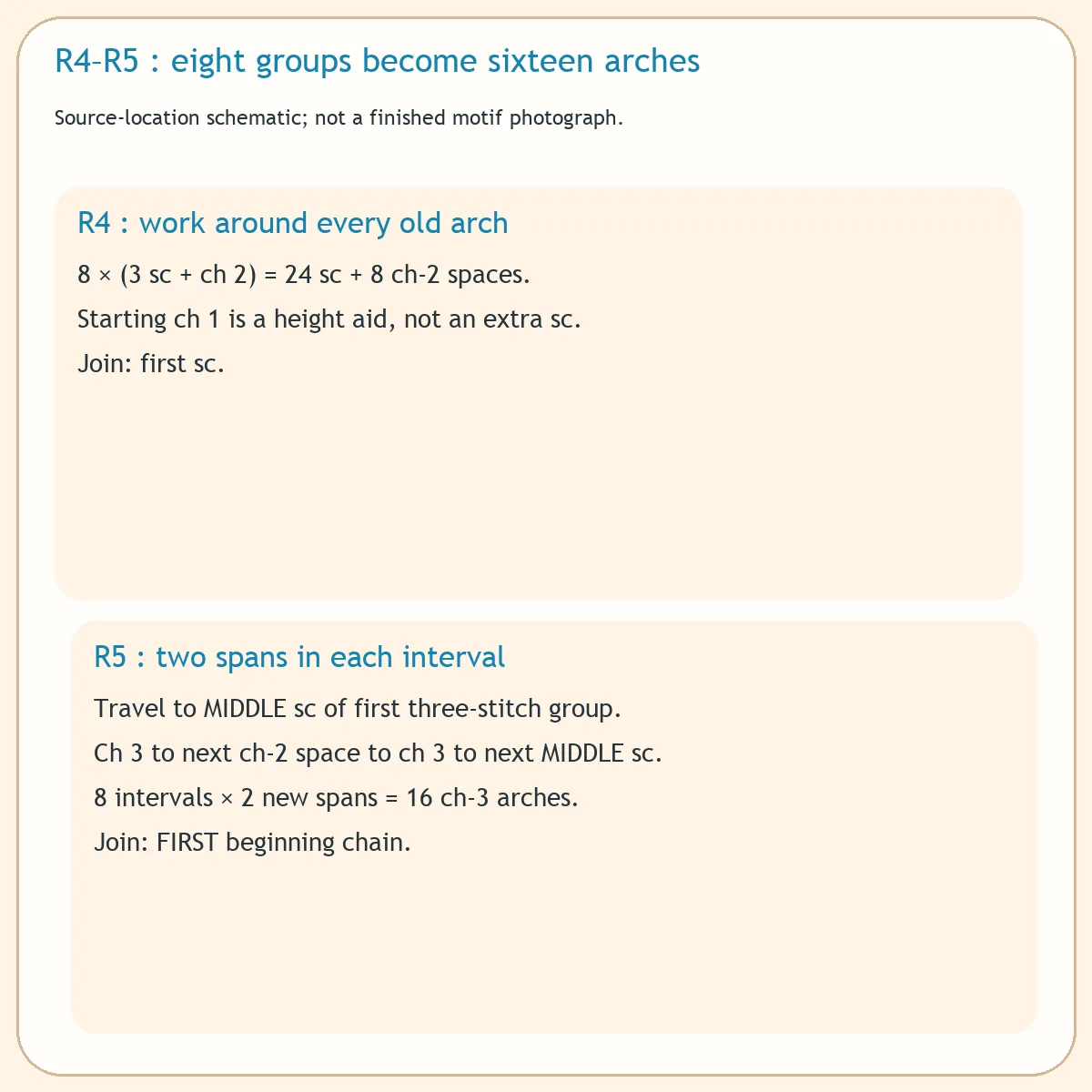
Slip stitch into the next reachable ch-5 arch. Ch 1 as a height aid. Into every arch, work 3 sc followed by ch 2. Join with 1 sl st in the first sc. Check: 8 groups of 3 sc and 8 ch-2 spaces.
Round 5
Work 1 sl st into the middle sc of the first three-stitch group. Ch 3, work 1 sl st around the following ch-2 space and ch 3. Anchor the chain with 1 sl st in the middle sc of the next group. Repeat this sequence around. Join with 1 sl st in the first chain. Check: 16 ch-3 arches.
Rounds 6 and 7: form the corners and outer edge
Round 6
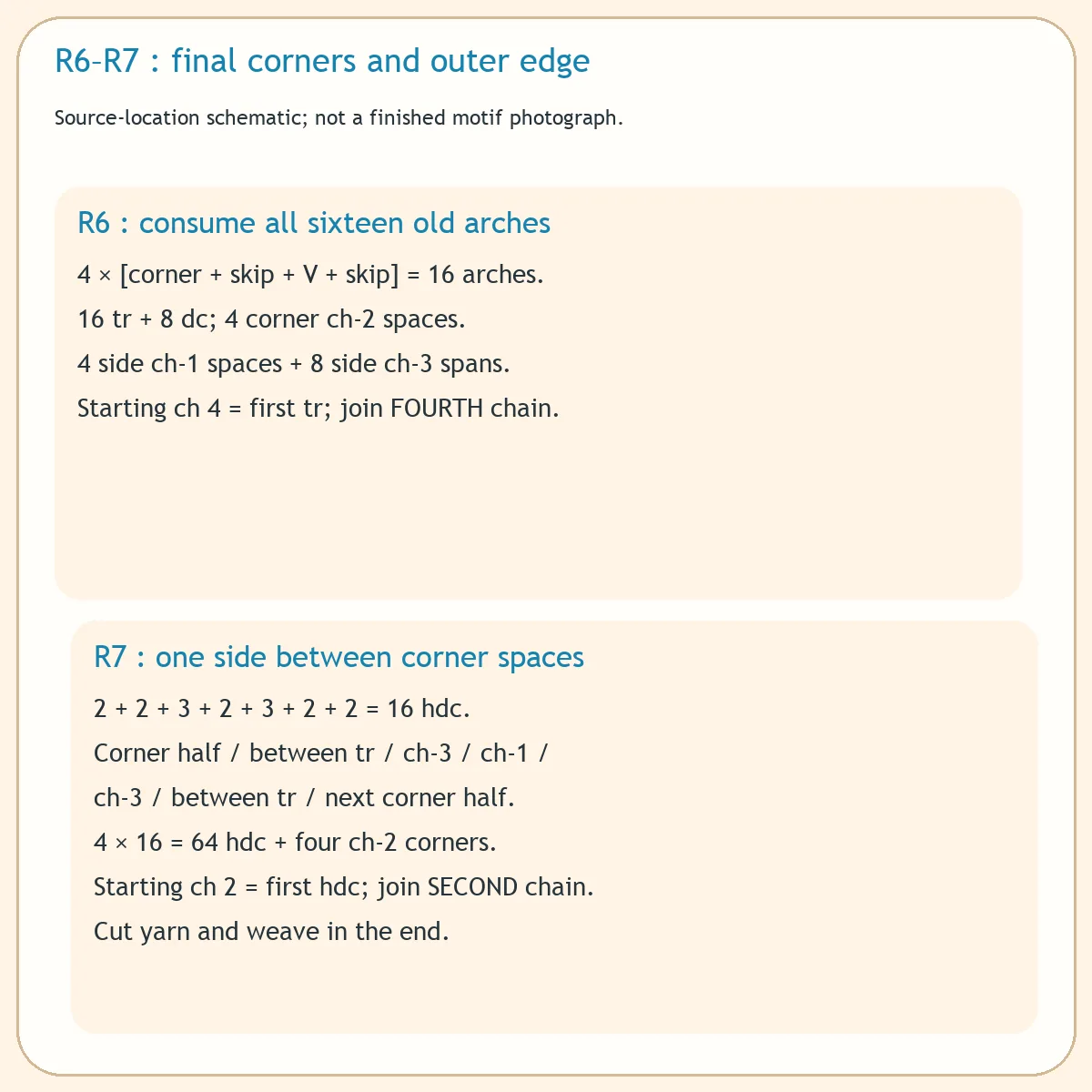
Slip stitch into the next ch-3 arch. Ch 4 as the first tr, then work 1 tr, ch 2 and 2 tr into that arch. For the next side, ch 3, skip 1 arch and work (1 dc, ch 1, 1 dc) into the following arch. Ch 3 again and skip 1 arch. Into the next arch, work (2 tr, ch 2, 2 tr) for the corner. Continue around to make 4 corners and 4 sides. Join to the fourth beginning chain.
Round 7
Slip stitch into the next corner space. Ch 2 as the first hdc, then work 1 hdc, ch 2 and 2 hdc into that same space. Along the side, work 2 hdc between the 2 tr, 3 hdc in the first ch-3 space, 2 hdc in the ch-1 space, 3 hdc in the second ch-3 space and 2 hdc between the 2 tr before the corner. In every remaining corner, work (2 hdc, ch 2, 2 hdc). After the final side, join with a sl st in the second beginning chain. Check: 16 hdc along each side from corner space to corner space. Cut the yarn and weave in the end.
Prepare both faces before offering the sample
The last round includes cutting and weaving the end. Inspect the reverse as well as the front, keeping loose strands out of the open areas. Lay the square flat and measure the actual side without pulling the arches to force a number. Use the real yarn care information for any further finishing and compare later samples in an equivalent finished state.
Look at the anchors before judging the appearance
Eight long arches are built from two different destinations
Round two alternates an anchor in the third double crochet of the same group with an anchor in the first double crochet of the next group. The last returns to the first double crochet of the first group. After that anchor, the closure goes into the first chain of the beginning arch. Keep the route intact rather than moving a loop to make the front look more symmetrical.
Round three travels through the eight existing arches and makes eight new chain-five spans. The slip stitches move the working position around the lace; they are not decorative extras to omit. A sample can look airy while still having a repeated or missed old arch. Follow the destinations around the whole round before relying on its general appearance.
The middle single crochet prepares the doubling
Round four places three single crochet and chain two in every old arch, creating eight groups and eight small spaces. Its beginning chain is only a height aid. The next round moves to the middle single crochet, then alternates chain-three spans toward the following chain-two opening and the middle stitch of the next group.
Those two spans in each of eight intervals produce sixteen arches. Do not count the original small space again as a new chain-three arch. It is an anchoring destination, not a replacement for the new span. If the opening looks unusually large, identify both actual endpoints before tightening or shifting the connection.
Keep the last two rounds together when reviewing the outline
Round six establishes the final corners. Each section uses a corner arch, skips one, uses the next for a double-crochet V and skips another. Four sections use sixteen previous arches. The result has sixteen trebles, eight double crochet, four chain-two corner spaces, four chain-one V openings and eight chain-three side spans. These different openings give the final round its insertion map.
The last round does not simply put one stitch into each visible top. It uses two half double crochet between treble pairs, three in each chain-three side space and two in the chain-one V space, with the written corner groups. Count the locations rather than guessing from how full a section looks. An omitted space cannot be corrected by adding a stitch elsewhere.
Read the edge from corner opening to corner opening
One side includes two stitches from the first corner half, two between trebles, three in a long side space, two in the V, three in the next long space, two between trebles and two from the next corner half. That is sixteen half double crochet per side and sixty-four overall, plus four corner openings. The beginning chain two is included as the first half double crochet.
The round-six join uses the fourth beginning chain; the final join uses the second. Earlier lace rounds close differently. Keep those destinations beside their own rounds. A tidy closure made in a more familiar chain would not preserve the complete source sequence, even if the finished edge initially seemed balanced.
Include useful notes with the handmade work
Write the chosen yarn, hook and your actual sample measurement on a plain card. Preserve the actual yarn-label care information. If several motifs are intended for one object, compare their completed edges before attaching them. Identical counts alone do not establish identical physical size across DK, Aran or different working tension.
The Sunburst gift sample offers a raised centre, while the granny earrings include their own small assembly. Their details do not become attachments or extra edging here. Explore the pattern collection and Sophie Willow's author page for other projects. Present this lace as the completed square it actually is, with clear openings and finished ends.