
 Sophie Willow
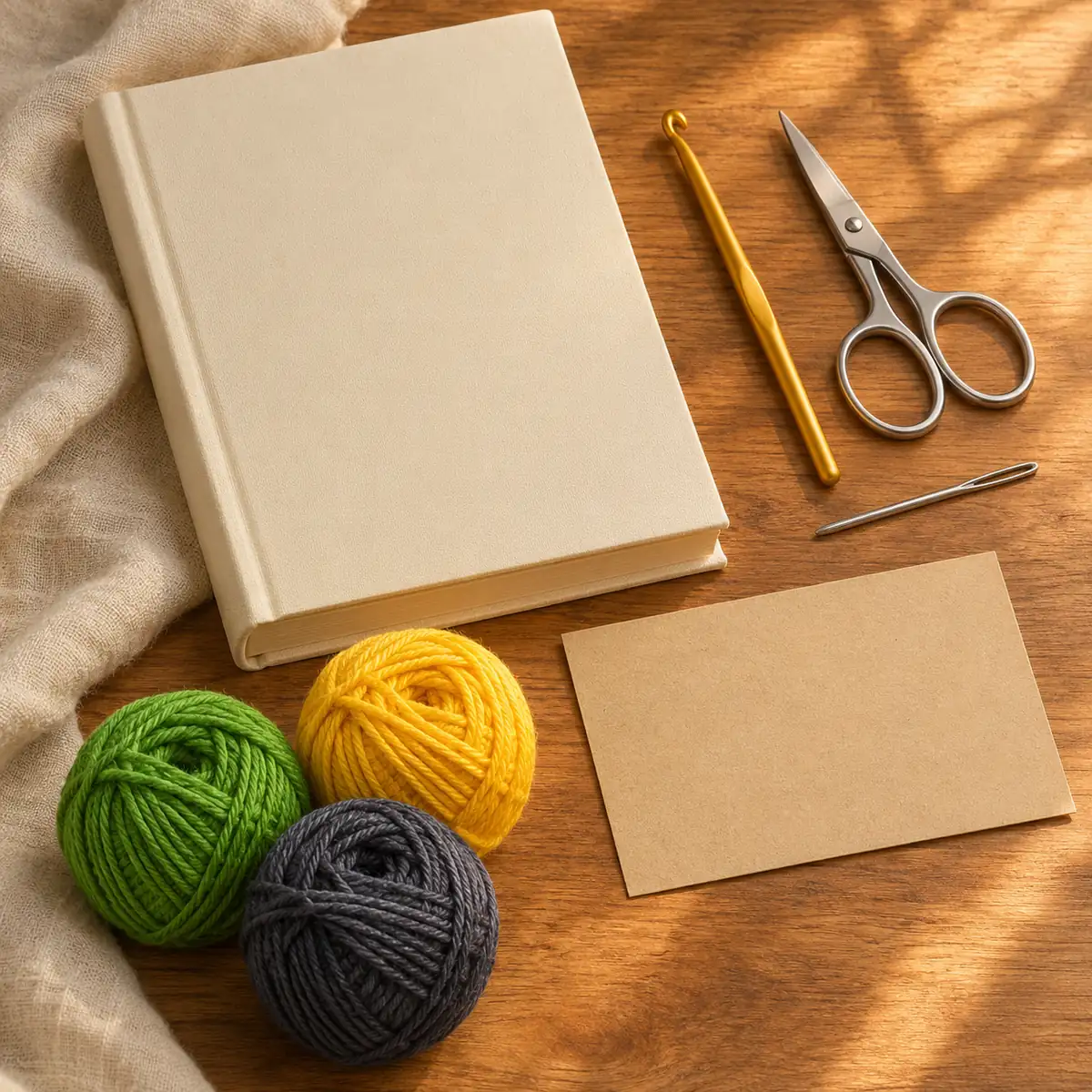
A flower bookmark makes a book gift personal through its chosen colours and its actual stem length. This source places a leaf at one end and a five-petal flower with a separate centre at the other. The narrow chain between them can follow the book spine, or use the given thirty-five-chain reference. This gift version keeps that allowed adjustment separate from the fixed leaf and flower counts, so a presentation choice does not quietly alter the crochet.
Plan around the book · Supplies and terms · Complete bookmark · Attach the centre · Review before gifting
Use the intended book instead of a promised universal size
The source explicitly allows the stem to match a book spine. Keep the book available while choosing that chain, and note the number actually made if you want to repeat the gift. When there is no particular book, thirty-five chains is the supplied reference. Neither option gives permission to enlarge the eight-chain leaf or add a sixth petal. Those pieces keep their full written route.
One possible colour combination is green leaf and stem, sunflower-yellow petals and a charcoal centre. Three yarn colours belong to three different roles; each choice remains separate from the sequence. The source example uses category 4 acrylic and a matching hook without a fixed millimetre number. It supplies no yarn quantity, gauge, final dimension or making time. A small material card should describe the actual yarn and tools rather than guessing those missing values.
Let the handmade object be complete before its card
The leaf and stem stay connected; the flower changes colour at the last stem chain; the centre is a separate piece. Complete that structure and its ends before arranging a gift photograph or wrapping. The bookworm bookmark gift offers a simpler one-colour comparison, but its free tail and short curl follow another pattern. It does not supply replacement counts for this flower-and-leaf version.
Prepare three colours and the finishing tools
You need yarn in three colours: one for the leaf and stem, one for the petals and one for the flower centre. The example uses size 4 acrylic yarn. Choose a matching crochet hook and have scissors and a yarn needle ready. A hot glue gun may be used to attach the centre. The source does not prescribe a numeric hook diameter, a yarn quantity, fixed final dimensions or a gauge.
The chain stem can be adjusted to the spine length of a particular book, as the source allows. If you do not have a book in mind, its given starting reference is thirty-five chains. This is a stated adjustment, not permission to change the leaf or petal counts. Record the chain length chosen if you want to repeat the same bookmark for a similar book.
US crochet terminology
This article uses US terms. Ch means chain, sc single crochet, hdc half double crochet, dc double crochet, tr treble crochet and sl st slip stitch. The stitch called a German Doppelstäbchen is a US treble crochet. The loop on the hook is not an additional completed chain. Count the chain links below it when locating the second chain from the hook.
The leaf changes stitch height along each side of the starting chain. Its turn is not a new row across the same stitch tops; you rotate the leaf and work along the other side of the original chain. Identify that chain before continuing so the second side lies opposite the first rather than forming a separate strip on top of it.
Flower bookmark: complete US instructions
Work the leaf around eight chains
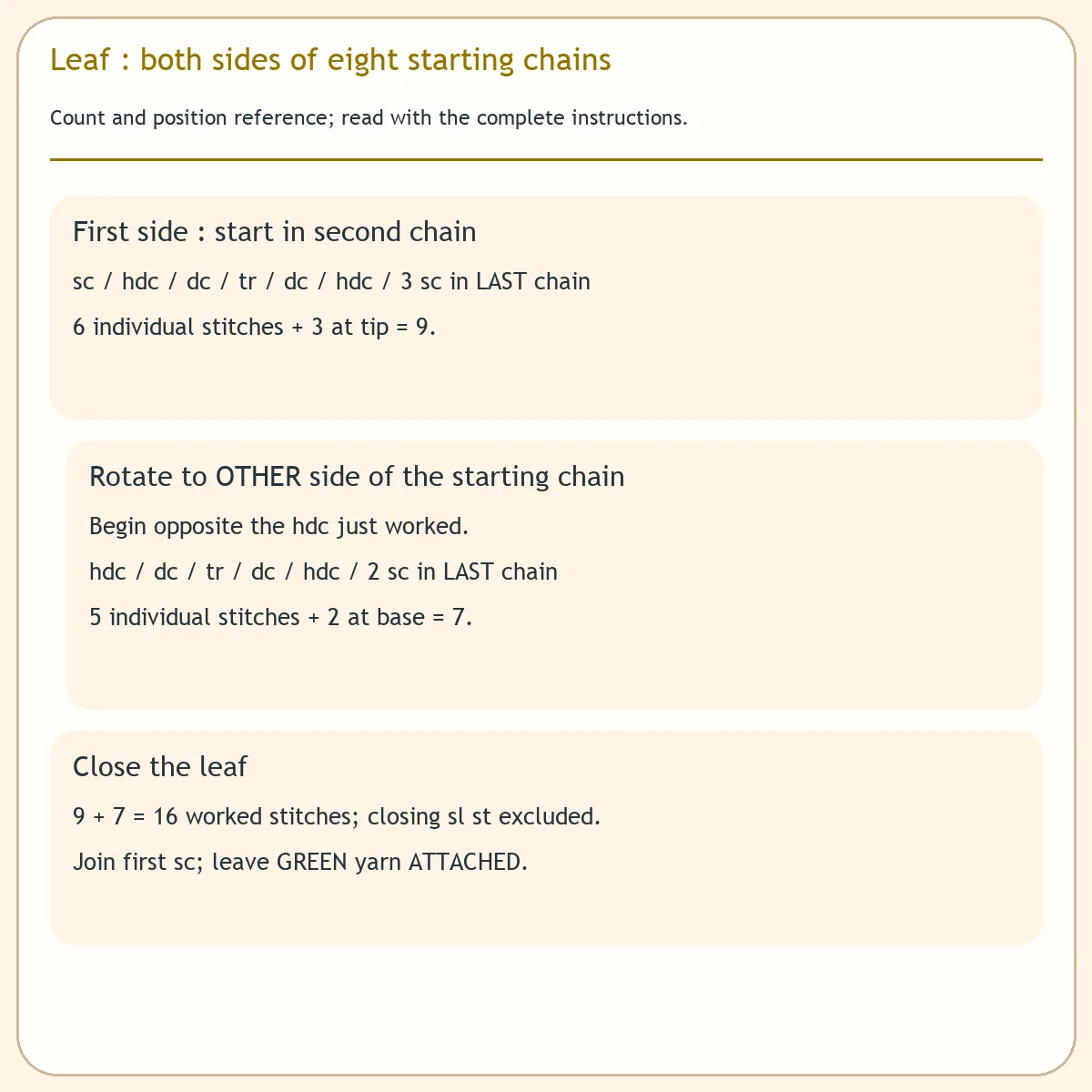
In the leaf colour, ch 8. Starting in the second chain from the hook, work one stitch in each position in this order: 1 sc, 1 hdc, 1 dc, 1 tr, 1 dc and 1 hdc. Work 3 sc in the last chain.
Rotate the leaf so that you can continue along the other side of the starting chain. Begin opposite the hdc just worked. Work 1 hdc, 1 dc, 1 tr, 1 dc and 1 hdc in the next 5 chains. Work 2 sc in the last chain and join with a sl st in the first sc of the leaf. Leave the green yarn attached.
Make the stem and five petals
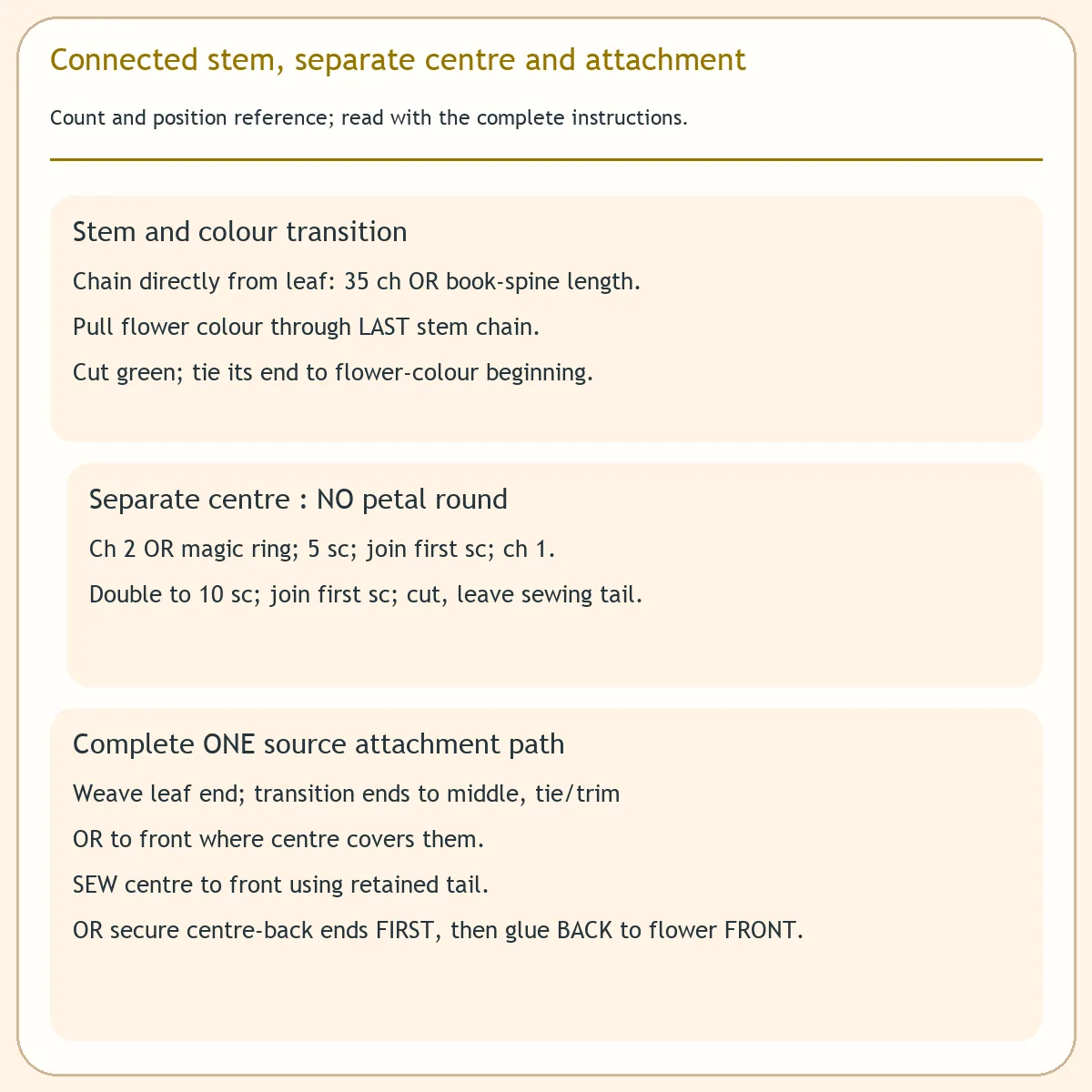
Directly from the leaf, work a chain the length of the book spine. If you do not have a particular book in mind, work 35 ch or adjust the number to your desired length. Pull the flower colour through the last chain of the stem. Cut the green yarn and tie its end to the beginning of the flower colour.
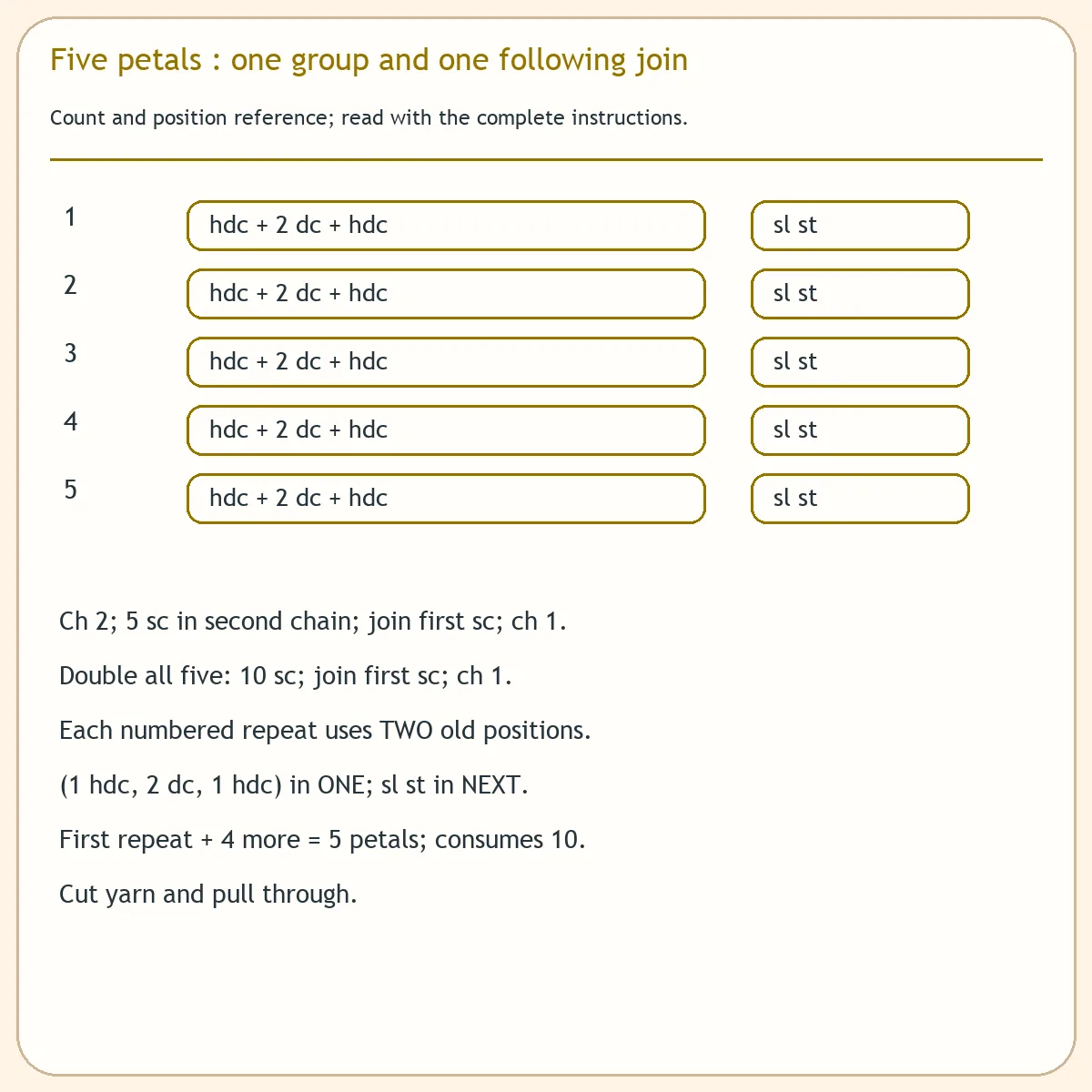
- In the flower colour, ch 2 and work 5 sc in the second chain from the hook. Join with a sl st in the first sc and ch 1.
- Work 2 sc in each of the 5 sc. Join the round with a sl st in the first sc and ch 1. There are 10 sc.
- Work 1 hdc, 2 dc and 1 hdc into the same next stitch. Work 1 sl st in the following stitch. Repeat this sequence 4 more times. You have 5 petals. Cut the yarn and pull it through.
Make the flower centre
In the centre colour, ch 2 and work 5 sc in the second chain from the hook. You may also work the 5 sc into a magic ring. Join with a sl st in the first sc and ch 1. In the next round, work 2 sc in every sc. Join with a sl st in the first sc. Cut the yarn and pull it through. Leave enough yarn for sewing.
Attach the centre and secure the colour transition
Weave in the end at the leaf. Draw the threads from the transition between stem and flower into the middle of the flower, tie them and trim them. You may also bring them through to the front because the round centre covers them. Sew the centre onto the front with the yarn end left for that purpose.
If you glue the centre, weave in and secure the threads on the back of the centre first. Then glue that back onto the front of the flower.
Review the leaf before the long chain hides its start
The second side goes around the foundation
The first side starts in the second of eight chains. Six separate stitch heights lead to three single crochet in the last chain. Rotate the leaf and work back along the other side of that same chain, beginning opposite the half double crochet just worked. The return has five named heights and two single crochet at the base. It is not a second row stacked on the first side’s stitch tops.
Nine worked stitches on the first side and seven on the return give sixteen, excluding the closing slip stitch. This calculation is useful if the small leaf seems uneven, but a total alone cannot prove the two sides share the correct foundation. Check the route as well as the number. Leave the green yarn attached after the join because the stem continues directly from it.
Keep the colour transition available for finishing
At the end of the chosen stem chain, pull through the flower colour, cut the green and tie its end to the new beginning. The source gives that order deliberately. Later, the transition threads are drawn into the middle of the flower, tied and shortened. They may instead come forward because the separate round centre covers them. Do not prematurely hide the ends where that route becomes impossible to follow.
The green chain is not a separately sewn cord. Cutting the leaf yarn immediately and adding a new chain later would change the construction. A neat-looking junction in a photograph cannot establish that the original connected method was used. Keep the actual sequence visible in your notes, especially if several bookmarks in different colour combinations are being made.
Five petals come from five two-position repeats
The flower starts with five single crochet in the second of two chains, joins and chains one. The next round doubles to ten, joins and chains one again. Each petal puts half double crochet, two double crochet and half double crochet into one old stitch; the next gets a slip stitch. The first sequence plus four more uses all ten positions and produces five petals.
Do not repeat five more times after the first. That would give six instead of the stated five. Keep the two old destinations together as one repeat when counting. The tall group and its low slip stitch both belong to the unit. If the flower looks crowded, review that unit count before spreading the petals by hand or adding a different centre to hide the problem.
Give the separate centre its own finishing path
The centre grows from five to ten single crochet but has no petal round. Its beginning may use two chains or a magic ring. Join in the first single crochet as written, cut and leave enough yarn for sewing when that method is chosen. It is a distinct piece even though its two small rounds resemble the beginning of the flower underneath.
For sewing, use the retained yarn to place it on the flower front after the transition ends are arranged. For gluing, first weave and secure the threads on the centre’s back, then glue that back to the flower front. These are alternative source methods.
Check what the gift note can honestly say
It can identify the real yarn, selected hook and chosen stem chain. If a finished dimension is recorded, measure the complete object and distinguish it from a source requirement. No exact finished size is supplied. Equal counts alone do not guarantee the same dimensions with other materials. Keep that difference clear rather than promising a universal fit for every book.
The supplied example uses acrylic of category 4; that example should not silently become a different fixed fibre specification. Keep the actual label if care information is needed. The source has no prescribed making time or yarn allowance.
Inspect all connections before the final presentation
Look at the woven leaf end, the green-to-flower transition and the attached centre separately. Confirm the leaf remains connected to the chain and the centre covers the intended area on the flower front. The decorative parts should not be used to conceal an unfinished tail or an extra petal. A complete count review and a view of both faces answer different questions, so give each its own moment.
The granny earrings gift project is another small use of yarn with its own attachment instructions. Its hardware does not belong to this bookmark. Find other ideas in the pattern collection or on the author page. Keep this gift’s finished record concrete: one leaf, a chosen permitted stem, five petals, a separate centre and all source connections completed.